• I’ve been talking about the coming of ebooks for years, and most of the time I’ve witnessed the shutters coming down and the yawns being stifled as I enthused about the future of electronic media.

    My argument has always been that one day the technology will be so seductive so clear and tactile that you wouldn’t want to read anything else.

    The same old arguments replay: You can’t read an ebook in the bath. (Yes you can, if it’s waterproof.) They are hard to read. (Not if the screen is paper white and dazzlingly high quality.) You can’t curl up in bed with an ebook. (You can if it’s soft and cuddly.)

    Recently, as ebooks and ebook readers have started to become a commercial reality, people have been asking my opinion as an author. Also I’ve recently become quite enamoured of cephalopods – squid and octopi – and I’ve come to think that in their study lies the real future of the ebook.

    Octopus skin is a brilliant video screen. It can imitate the colour and pattern of its surroundings perfectly. The technology that lets octopi do this would make and incredible ebook reader screen – rock solid with no flicker or bright backlighting, which tires the eyes.

    But the amazing thing about octopi is that they can change the shape and texture of their skin at will. That is the way to make ebooks irrisistable.

    My big argument against ebooks is that they are homogenous. Real books are individual objects that you can have a relationship with. They have a smell, weight, texture and design all of their own. The physical ebook reader, the kindle or iPad is always the same and has a blanding, levelling effect on the software part of the book. The screen is always the same.

    How amazing would it be if the reader (the octopad or cephal-ipod!) changed its shape and texture to suit the book? If it could emit smells and watch your reaction to the text, it could set the scene and atmosphere and bookmark the point at which you fell asleep.

    Changing the texture and shape of the reader would make each new ebook new, fresh and original, not like all the other books on you ebookshelf, as they are today.

    This will come, It will happen. I don’t know when, but it will. I’m sure that there are labs out there already working on it – bringing electronics and biology together.

    And of course if your ebook reader is half octopus, it will be quite happy if you drop it in the bath – in fact it will probably find the soap for you!
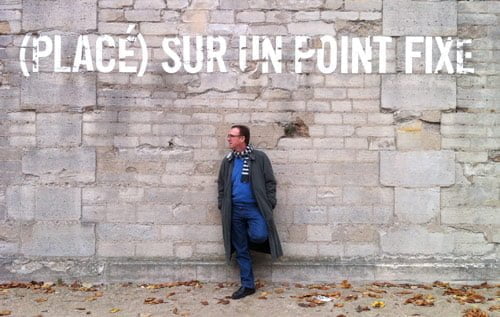
  • I couldn’t resist this! The Words (PLACÉ) SUR UN POINT FIXE, which translates roughly as (Placed) on a fixed point, were writ large upon a wall in the Tuileries Gardens in Paris. What a photo opportunity for the album cover for the Album I will probably never make! But then again, you never know – It could inspire me to get my greatest hits together…


  • I’ve just spent four days visiting art galleries, museums and churches in Paris and I’m quite zapped out with art. My head is spinning with ideas and insights. The most difficult juxtaposition to reconcile was the Murakami exhibition at Versailles.

    Takashi Murakami makes giant manga-inspired works of art. At first sight they look like advertisements for Bandai Tamagotchi Toys. But of course it is the other way round. The tamagotchi toys and the manga books and movies are the inspiration for his art.

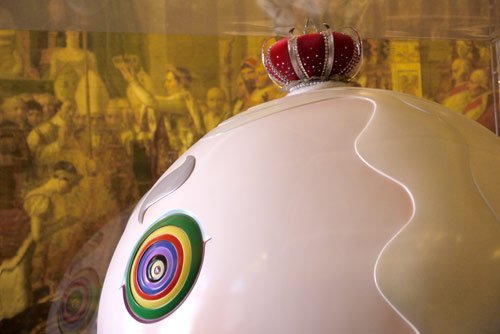
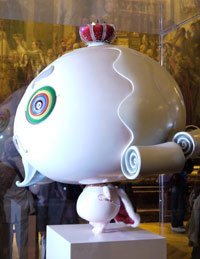
    The picture above is of an installation/model (call it what you like) called “The Emperor’s New Clothes”. Now Murakami is really playing with our heads! It is set in a vast, ornate room at the Palace of Versailles, in which hangs an enormous painting of Napoleon Bonaparte crowning Josephine his Empress.

    The Painting – high art as we have come to understand it – is not mocked, but questioned by the new upstart.

    To western eyes the Murakami looks like a cheeky shop window display – cute and ephemeral. “Oooh! It’s manga!” I heard several people say, as if that made it all okay. It would be similar to the Japanese staring at the Mona Lisa and saying, “Oooh! It’s a painting!”

    Of the two, old painting and the new installation, the new actually asks more questions about Art than the old ever will. A painting of Napoleon crowning Josephine is not high art. At it’s best it is illustration or historical record keeping, at its worst, shameless propaganda.

    At First, I thought Murakami’s work was just tongue-in-cheek fun, until I Came to his last installation. The carpet was a ridiculous, dizzying quarter-acre of smiling,happy daisies. On the back wall, a huge panel displayed more happy daisies on a gold background. But then I realised that it wasn’t a panel, but really a modern version of an antique Japanese screen that I would normally admire with a sense of reverence. I love Japanese art for it’s quality and and high craftsmanship.

    And then I understood Murakami’s game. He takes the myths and heros of modern storytelling – manga and anime – and translates them into gaudy objects of ostentatious wealth and power through high craftsmanship. These are then placed into an environment that did exactly the same with Greek and Roman myths and heroes some three hundred years ago. Time and propaganda has taught us to revere Versailles’ glories of the past – Murakami is teaching us to see, understand and begin to revere the glories of the present.