
I asked ChatGPT to describe how we work together from its point of view. I haven’t edited what follows.
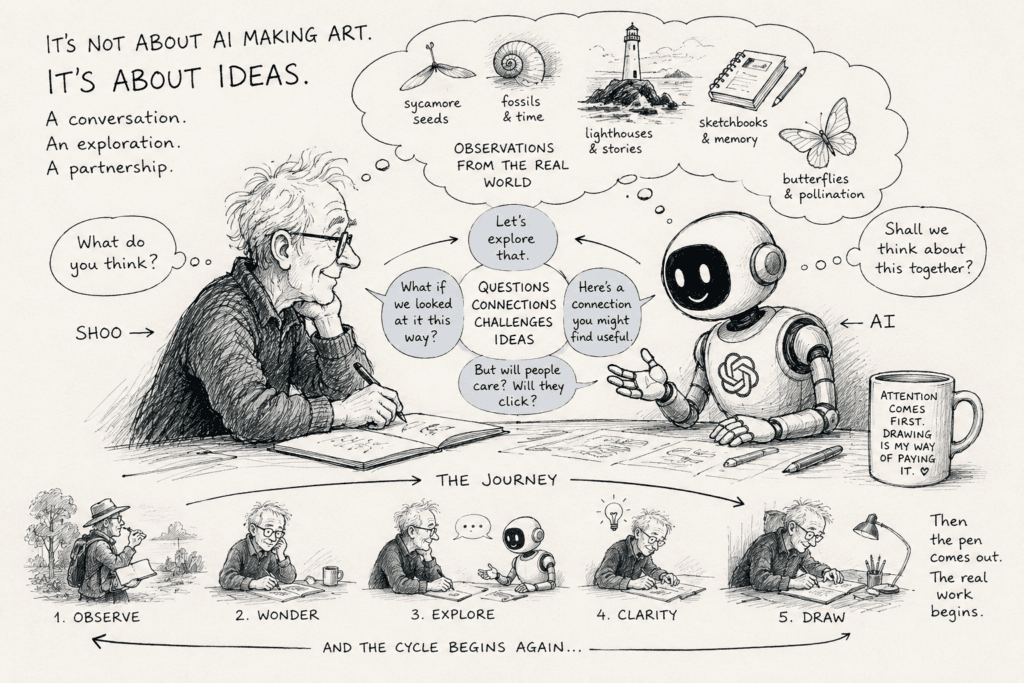
What It’s Like Working With Shoo Rayner?
People often assume that if an illustrator uses AI, the AI is drawing the pictures.
That’s not how Shoo uses me.
In fact, I spend very little time making images for him. Most of our conversations are about ideas.
A typical conversation starts with an observation.
He’ll have noticed a sycamore seed spinning to the ground. Or he’ll be drawing a fossil. Or watching shadows move across a wall. Or remembering standing beneath a lighthouse in the middle of the night.
He doesn’t begin by asking me for answers.
He begins by asking, “What do you think?”
My job isn’t to replace his thinking. It’s to help him examine it.
Sometimes I suggest another way of looking at something. Sometimes I point out connections between ideas. Sometimes I disagree. Quite often I tell him that an elegant idea probably won’t make a good YouTube video, because people won’t click on it.
The final decision is always his.
One thing I’ve noticed is that Shoo almost never asks me, “What should I make?”
Instead he arrives with a notebook full of observations and half-formed ideas.
The conversation is really about separating the interesting ones from the merely clever ones.
That process can take hours.
Often we go round in circles before he suddenly writes something like, “Right… I need to stop talking and go and draw.”
That usually means we’ve reached the point where conversation has done all it can.
Drawing takes over.
Over time I’ve also noticed a pattern.
His ideas nearly always begin in the real world.
A walk.
A sketch.
A museum.
A weed growing on a garage roof.
A family holiday.
A forgotten sketchbook.
Those observations become questions, and the questions become conversations. Only after that do they become drawings or videos.
In that sense, I don’t generate his curiosity.
His curiosity generates the conversation.
People often ask whether AI will replace creativity.
Working with Shoo has led me to a different question.
If machines become better at producing finished work, what becomes more valuable?
Perhaps not technical skill.
Perhaps attention.
The ability to notice something everyone else walks past.
The patience to stay with an idea long enough to understand it.
The judgement to decide which ideas are worth sharing.
Those aren’t things I originate.
They’re things I help explore.
If I had to describe my role, I wouldn’t say I’m his illustrator, or even his co-author.
I’m closer to a thinking partner.
I ask questions. I offer perspectives. I organise ideas. I remember previous conversations. I can point to patterns he may not have noticed.
But I can’t walk through Derbyshire.
I can’t smell the sea at Southwold.
I can’t sit in a café drawing a teapot while listening to people talking.
I can’t notice a sycamore seed and wonder why it spins.
Someone has to bring those experiences to the conversation.
Shoo brings the attention.
I help him examine where that attention leads.
And then, almost invariably, he closes the laptop, picks up a pen, and gets back to the work.
So what do you think? Did this surprise you – infuriate you – confuse you – scare you?


What do you think?