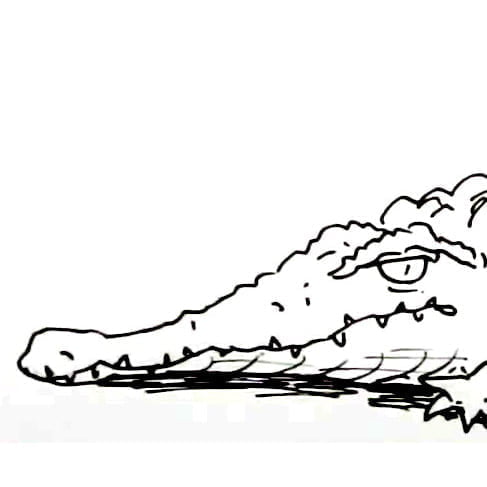
• Here’s the latest video, how to draw a seal. Actually it shows you how to draw a seal and a sea lion. There are subtle differences in the ears and the flippers. Then Sea :ion can bend it’s flippers underneath and use them as feet to walk on. Seals just have flippers and have to lurch and lunge themselves around on dry land.


  • I went for a walk in the Forest this week, and the sap is definitely rising. Although a cold wind is blowing from the north, Spring is here at last.

    You can see it best in the ferns that are bursting out of the ground everywhere you look. I love the way they uncurl and open out as if they are all packed away underground, and are just being blown up inside, like curly, party blow-outs tooters.

    There used to be a quaint tradition here, where young lovers would go into the Forest for a bit of privacy. It was known as a Fern Ticket. I remember the local paper printing Fern Tickets for you to cut out and give to someone you admire to let them know you wouldn’t mind a private walk in the Forest with them. If That doesn’t get the sap rising, I don’t know what does!


  • I just caught the end of an interview with Michael Rosen on breakfast TV this morning. He was asked why we should bother to read books now that reading is going over to Kindles and iPads.

    He hesitated a moment, the same way I hesitated last week when asked for a quote by the Hereford Times, on wether I thought Libraries were important. I’d just been posing for photograhs in the new Garway School Library. I’d cut the ribbon to open it and was feeling full of the joys of spring.

    “So, Mr Rayner, can you tell me why you think why books and libraries are important?”

    …it’s so obvious that there isn’t a clear answer that doesn’t sound like a well-used soundbite that justifies keeping open expensive institutions. And as for books – who needs them when everything you need is all online for free?

    There is something about a book. It is an object with a life of its own, unlike an electronic file that can be stored anywhere and easily corrupted. It takes time to make a book. If well edited, it is an accessible chunk of someone else’s brain. It’s a considered thing, with an obvious beginning, middle and end. It doesn’t flit about from page to page and the batteries never run out. It even works in candlelight. A book is the quickest way into the mind of another person. It’s a time machine. It is knowledge hard won by our forebears, hard won and easily lost. The book is a wonderful thing.

    But I’d rather go to an online source for factual knowledge than an out of date encyclopaedia. The book is not everything.

    But there is something about a book – it’s very physical presence – that lets you read the text in a one-to-one conversation with the author, in your own time, at your own pace. This doesn’t happen on the screen where all text is homogenised and links want you to jump about, leaving the considered argument half way. Electronic text looks and smells the same and is delivered within the same unit every time. Books have an extra life – a smell, texture, weight and age.

    I don’t think the book will disappear. Printing a book lends authority to the author (that’s where the word comes from). Buying a book says something about who you are that is different to a browser history of links.

    And what of Libraries? Without them, what are we as human beings? Without Libraries there would have been no civilisation. Now we have Libraries in abundance we feel we can afford to lose a few, but where do we stop? When the Barbarians are warming their hands on the burning books?