
Yesterday I went up to visit my Publishers in London but in the afternoon I visited the Cosmonaut Exhibition in the Science museum.
It was wonderful to see the hardware that I’d only ever seen before on grainy newsreel footage.
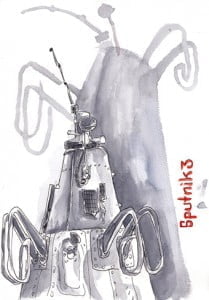
Sputnik 3 was probably my favourite. It must have had some influence on the design of Dr Who’s Daleks! I never understood what the curly metal appendages were for – apparently they were radio antenna.
So many risks were taken by the Russians to get one step ahead of the Americans in the Space Race. Some of their technology was pretty crude compared to the Americans, but with a bit of propaganda and subterfuge the Americans were led to believe they were far more technologically advanced than they really were.
I was amazed to see the Lunakhod lunar landing vehicle. I didn’t know anything about that. It has a very similar design to the LEM but is more chuncky and uses they iconic Russian Sphere shape.
A wonderful exhibition. Well worth seeing and thanks to all those who organised it and put it on.
Yesterday I went up to visit my Publishers in London but in the afternoon I visited the Cosmonaut Exhibition in the Science museum.
It was wonderful to see the hardware that I’d only ever seen before on grainy newsreel footage.
Sputnik 3 was probably my favourite. It must have had some influence on the design of Dr Who’s Daleks! I never understood what the curly metal appendages were for – apparently they were radio antenna.
So many risks were taken by the Russians to get one step ahead of the Americans in the Space Race. Some of their technology was pretty crude compared to the Americans, but with a bit of propaganda and subterfuge the Americans were led to believe they were far more technologically advanced than they really were.
I was amazed to see the Lunakhod lunar landing vehicle. I didn’t know anything about that. It has a very similar design to the LEM but is more chuncky and uses they iconic Russian Sphere shape.
A wonderful exhibition. Well worth seeing and thanks to all those who organised it and put it on.
 I was mad about space when I was a child. I was just old enough to be aware of the excitement of Yuri Gagarin being the first man in space. My early years were dominated by Fireball XL5, Thunderbirds, Captain Scarlet, Telstar, zoom ice lollies, Mercury, Gemini and Apollo.