• teenager ?Every year I go to Monmouth Comprehensive School to try and give some advice to students about writing and illustrating as a possible career. There used to be a sort of career path I could suggest but, thanks to the Internet,  so much has changed in the last four or five years, I went last night wondering what to say.

    Every one who came to talk to me was different. Different aims, ideas and levels of ambition. I had different conversations all night, but themes did repeat themselves. Here are a few things I remember saying more than once.

    Do you want to be an artist or a craftsperson?

    There is a difference. An artist originates ideas, a craftsperson turns those ideas into a physical reality. Many Artists are experts in their craft, but not all craftspeople are Artists – they make beautiful art but not from their own, original brainwork. A craftsperson is more likely to get work in the artistic field, and many people are happy just to be able to be in the artistic world in any way they can.

    An Artist may well starve or they may become fabulously successful because they are originals and reap the reward.

    Be different.

    That’s easier said that done as a teenager. Standing out from the pack can bring unwanted attention. But if you want to be a successful artist you need to be different so that you reflect back the world so others see it in a way they have never seen before.

    To be successful you need to be recognisably different. Copy other people’s work as you learn, but always ask yourself, “What Have I learned from copying this? How do I bring these ideas into my own work and move these ideas forward into something new?”

    Draw.

    For illustration and other visual media, drawing is the core skill. By drawing every day, you build up a knowledge of how the world works and develop eye-brain-motor skills. It is simple you paper and pencil. There is nowhere to hide!

    When you want to make art, you don’t want to have to think about the process. You want to be able to concentrate on the image or the idea, not your lack of skills and understanding.

    Draw when you are at the bus stop, in cafes, out shopping, draw the dog, the cat, Grandad fast asleep in front of the TV.  You have no excuse to be bored. Pick a pencil and draw whatever is in front of  you. Keep drawing it until you get it right!

    Read.

    This goes without saying. Reading connects you straight to the mind of the author. Movies are a mediated interpretation. You learn a lot about how other people think by reading.

    Live.

    Just say yes to experiences that are offered to you. The more you say yes, the more seems to get offered. If something is a bit oiut of your comfort zone, try it any way. Push yourself a bit. You can only get new and original ideas if you have lived a bit and have some experience of life.

    X-Factor is not reality.

    The winners of reality shows have put years of practice and learning in before they ever apply to be on the shows. The TV doesn’t tell you that. TBV needs to sell you a fairy tale dream.

    Don’t be in a hurry.

    The plain fact is that you are still young and don’t have a huge amount of experience. That’s okay. You have a whole life-time in which to grow up! If you feel you want to be original but don’t have any good ideas, don’t worry, just keep working at it. Ideas come when you put different ideas and experiences together, so you have to have lots of small ideas and experiences in your storehouse before you can start to make the connections. Do stuff, build up your experience and increase your knowledge.

    Keep a journal or sketchbook.

    Journals and sketchbooks are like idea batteries you can go back to when you need recharging. This is where you will find your connections. If you don’t make a note of an idea, within seconds it will be lost forever.

    If you feel called, nothing will stop you!

    Art is a vocation. If you really want to be an artist, nothing will stop you. You may have to make some serious sacrifices along the way.

    A degree means nothing in the career of an Artist

    As an Artist you will be judged purely on the quality of your work. No one buys a painting because you have a degree. BUT! Art college or Uni gives you time to try things out and make mistakes under the tutelage of teachers who understand what kind of person you are. It also gives you time spent with other student artists. You will feed off them as much as they feed off you. Make use of this time. Art college or Uni should be fun but it should not be a three year party with no work! It is a fabulous opportunity to find out who you are and build the ground work of your original ideas.

    You may also decide at some point that you want to be an art historian or work in museums or galleries or go into some other artistic field where qualifications count. As you go through your artistic career you will become aware of jobs and fields of endeavour you never knew about before. One day you matt well find something and say, “This is me!” So be prepared and have some great qualifications to back you up, just in case.

    Choose the subjects that will obviously support your artistic path and then choose the subjects you enjoy and will do well in. Make sure you get the best grades you can, just in case you find yourself on a different path that needs the qualifications.

    Be lucky!

    There is no such thing as luck. Luck is making sure you are in the right place at the right time with the right people with the right knowledge and experience behind you.


    Any other advice you would like to add to this from bitter experience!?


  • power of booksThe older I get, the more I realise that there is never one simple easy answer. Duality or multiplicity is built into the fabric of life.

    Yin/Yang, Left/Right, Relativity/Quantum theory. All systems work happily enough, but each needs the other to make sense of the whole.

    So it is with learning to read.

    The mechanistic approach to reading of phonics is great – breaking down the language into its composite parts to create building blocks.

    I’m a great advocate of this axiomatic approach. Start with the very basic truth or fact about the subject that everyone can agree on, then build upon that foundation, step by step, block by block.

    You may have read my book, Euclid, the man who invented geometry. Euclid is the classic, axiomatic approach to learning geometry. But geometry is boring, boring, boring if you never have the chance to see the angles being created, or to stab yourself with a compass and bleed on your exercise book or feel the exhilaration of drawing a perfect circle. There has to be fun and there has to be a reason to it all.

    When it comes to reading, you can fill a child full of phonics, but you can’t make them read. Phonics won’t make them want to read. Phonics are mechanical, they have nothing to offer, no fun, no reason.

    Phonics only make sense in conjunction with stories. Stories are what captivate a child’s imagination, not phonics.

    Phonics are meaningless to a child unless they begin to see a connection between the mechanics and the prize. The prize is the story. Why else should they bother learning phonics?

    There are no more magical words to a child than, “Shall I tell you a story?” Say them and you’ll have their immediate and rapt attention. It’s an extraordinary power. You don’t even have to be good at telling stories, just choose a good book, open it and off you go. Trust the author and the editor who put their life’s experience into getting the story just right, so you can be a hero to the children you read to.

    This works with adults too. Try it!

    For every minute spent on phonics an equal minute needs to be spent on story time, otherwise phonics don’t make sense. Phonics and grammar and structure and spelling only make sense when you know what it is that they all add up to… the prize, the story.


  • MonstaThere is only one way to learn how to write well, increase your vocabulary and really begin to understand grammar and language structure. You need to experience writing in action, by reading it and listening to it.

    As we read, we imbibe new words, new idioms, new turns of phrases, new ways of breaking the rules of grammar and structure. We learn new ways of telling stories.

    Stories grip us wether they are overheard in the playground, on the news, the adverts, the gossip columns, the movies, the latest video game or in books.

    Stories are the powerhouse, the fusion and fission of learning to read and write.

    Writing can only become imaginative, exciting and able to engage the reader if the writer knows what is possible, if they have read and seen how others do it, if they realise that language is not a straight jacket, but a universe of infinite possibilities.

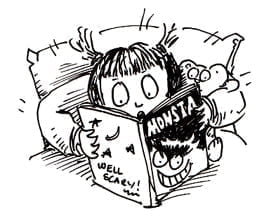
    Stories are what grip us and hold our attention. Stories are what take hold of a child’s imagination and make them want to open the covers of a book, to delve inside and discover what wonders are contained therein.

    And I do mean a book. Kindles and tablets are fine when you are confident and know what you are doing, but learning the language is hard work, requiring deep concentration. One thing at a time – beginning, middle and satisfying end.

    Kindles and tablets are multifunction shopping and entertainment devices. Distraction is built-in a mere swipe away. Tablets have only one page. They have no identity. They homogenise the content they envelope.

    Often, distraction is built right into so-called “reading apps”. You cannot learn to read if the words are jumping up and down and doing the reading for you.

    Hearing stories makes children want to read them. To be able to hear stories, to know what those books contain, the stories must be told in the first place. Every other lesson in primary school comes second to story time. Every bedtime routine comes second to story time. Story time is where readers and writers are made.

    When that magic moment happens – when children make the connection and realise that the little squiggles on the page are the code that connects them to a multitude of worlds and other people’s lives – they want and need to read books by themselves – hundreds of them! They need books to be available and they might need a bit of help choosing them.

    That’s when you might start to engage them with the intricacies of structure and grammar.

    A child that reads for pleasure will want to write, to try and do this amazing trick for themselves. They will be bursting to tell about everything they see and hear and experience. Knowing that others have done this before them, and seeing how they did it, will help them tell their own story, be it scientific or spiritual, funny, happy or sad. They will have learned it is possible to make a story so engaging that others will want to read and listen to what they have to say.

    Reading is seeing how writing is done.

    Reading for pleasure is how we learn to write.

    Reading for pleasure comes first.