
• I so loved this article and agree with everything it says, I wanted to republish it as I am allowed to. Many thanks to Misty Adoniou.

    Want to improve your kids’ writing? Let them draw

    By Misty Adoniou, University of Canberra

    We might see drawing as a bit of fun, but the contribution to learning is more than we might think
    Shutterstock

    We love our kids’ first drawings. They draw before they write, so their drawings seem somehow miraculous in those early years – their first communication that is permanent and there for all to see.

    Preschool is all about drawing and painting. Large canvasses of abstract finger paintings give way to recognisable broad stroke figures, houses, and sunny skies. We celebrate every image and give them pride of place on the fridge door.

    The disappearance of children’s drawings

    Once school starts, nobody really takes drawing seriously anymore. In the classroom, drawings begin to take second place to writing. Young children quickly learn that success at school is measured by how well you can read and write, not by how good your drawings are. Their drawings are now just decorations that they get to do if they finish their writing.

    Too often in classrooms we view drawing as a crutch, or a distraction that we want children to grow out of, so they can focus on the ‘real’ task of writing.

    But we seriously misunderstand the function of drawings, and their contribution to learning, if we think they are just what children do when they can’t yet write.

    Drawing is not the evolutionary inferior to writing – writing and drawing are two distinct communication systems, and each deserves their place in the communicative repertoire of our children.

    Drawing improves writing

    Drawing and writing support each other. The poet e.e.cummings was both an artist and a writer, and when asked whether these two pursuits interfered with each other, he replied,

    ‘On the contrary, they love each other’

    And his experience is backed up by the research.

    Children who draw before they tackle writing tasks produce better writing – it’s longer, more syntactically sophisticated and has a greater variety of vocabulary. It is likely this is because the act of drawing concentrates the mind on the topic at hand, and provides an avenue for rehearsal before writing – rather like a first draft where they can sort things out before having to commit words to a page.

    Drawing a picture can help children arrange their thoughts
    Shutterstock

    If you have ever read a 10 year old’s long and winding story you will know how much a first draft would enhance comprehensibility. And if you’ve ever taught 10 year olds you will also know they are not terribly inclined to do multiple written drafts. They’d rather sum up all their story’s inconsistencies with ‘It was all a dream’ than follow a teacher’s suggestion to go back and make significant changes.

    As a first draft, drawings are much easier to erase, to add to, and to rearrange. They provide a common reference point for the teacher and the child to discuss the story before it is written, and this is an important additional oral rehearsal that strengthens the quality of the writing. Ideas are clarified and vocabulary strengthened.

    The message to teachers is a simple one – instead of telling children they can draw a picture if they finish their writing, have them draw before writing.

    Just for the talented few?

    Drawings are not the sole province of the ’talented’. Of course there are children with a natural talent for drawing, but they shouldn’t be the only ones who enjoy drawing, any more than we think only the naturally talented writers should write.

    Everybody should have the opportunity to use drawing as a means of expression and communication – just as everyone should learn to write. And for those children with a drawing talent, closing down drawing in the classroom can feel to them like just another brick in the wall.

    Everyone can learn to draw

    Drawing is a teachable skill, just as writing is. Most of us have a romantic notion of drawing – we see someone who produces life-like images and sigh, knowing we could never do that.

    The child who claims to be bad at drawing, furiously erasing parts of their drawing till the paper wears away, has probably learned what ‘good’ drawing is from unthinking comments from adults who have ‘helpfully’ observed that the sky isn’t red, or that their Easter bunny looks like a kangaroo.

    Indeed there does come an age, usually around 8 or 9 years, when we begin to see our drawings as others do, and most of us are usually disappointed with what we see – and give up on drawing. But actually, with tuition and encouragement, all of us can learn to draw pretty well, and more importantly, feel the pleasure that comes with this kind of expression.

    To promote a classroom where drawing is valued, get rid of colouring in stencils. Let kids freehand draw and paint, and don’t be afraid to teach some drawing skills so they can get what is in their mind’s eye down on paper. You won’t be stifling their creativity, you will be ensuring they never lose it.

    Drawing helps in other academic areas

    We understand things more deeply when we see them from multiple perspectives. Drawing what you have understood from a reading passage, drawing the science experiment you have just done or drawing the detail of an autumn leaf are all examples of engaging with the same learning from a different angle.

    For most children, this helps consolidate the learning but for some children it can be the key they have been waiting for to open the door to the learning. The confidence and self belief this gives them can change their attitude and engagement with other aspects of schooling.

    Closing doors and building walls

    If our only measure of success at school is performance in standardised literacy and numeracy tests, schools will be tempted to narrow their curriculum and to sideline the Arts. It is already happening

    This is disastrous, not just for the Arts and all their intrinsic worth – but for the reading and writing skills we are so focussed on improving.

    Drawing improves children’s writing, and can enhance learning in other areas – so let kids draw.

    The Conversation

    Misty Adoniou does not work for, consult to, own shares in or receive funding from any company or organisation that would benefit from this article, and has no relevant affiliations.

    This article was originally published on The Conversation.
    Read the original article.


  • Click for more info
    Click for more info

    You may have seen the videos I made on my DrawStuffRealEasy channel about Euclid, a genius Ancient Greek guy, who devised a brilliant and simple step by step method of teaching geometry.

    Those videos made me realise that there is a similar step-by-step way to teach the basics of drawing, that is easy and not scary, if you are really a little bit unsure of your hidden skills.

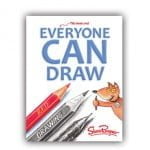
    My new book, Everyone Can Draw, explains the basics of drawing with links to helpful videos on my channels.

    I think drawing is like writing – you need to learn the letter shapes to make the words to make the sentences that make sense.

    This book will be the foundation of a new style of drawing video that I will be making soon on my DrawStuffRealEasy channel.

    Signed copies are available from me for only 4.99 plus postage (that’s around €6 in Europe, or $8.5 in the US and Canada depending on the exchange rate.) The first 30 orders will also get a free poster of me to cheer up your walls!


  • Click for more info
    Click for more info

    You may have seen the videos I made on my DrawStuffRealEasy channel about Euclid, a genius Ancient Greek guy, who devised a brilliant and simple step by step method of teaching geometry.

    Those videos made me realise that there is a similar step-by-step way to teach the basics of drawing, that is easy and not scary, if you are really a little bit unsure of your hidden skills.

    My new book, Everyone Can Draw, explains the basics of drawing with links to helpful videos on my channels.

    I think drawing is like writing – you need to learn the letter shapes to make the words to make the sentences that make sense.

    This book will be the foundation of a new style of drawing video that I will be making soon on my DrawStuffRealEasy channel.

    Signed copies are available from me for only 4.99 plus postage (that’s around €6 in Europe, or $8.5 in the US and Canada depending on the exchange rate.) The first 30 orders will also get a free poster of me to cheer up your walls!

    The eBook is also available as an instant download by clicking the link below.